Escorts Information Canada
Curated by Cachet Ladies – Toronto’s Premier Escort Agency
History of Escorts in Canada
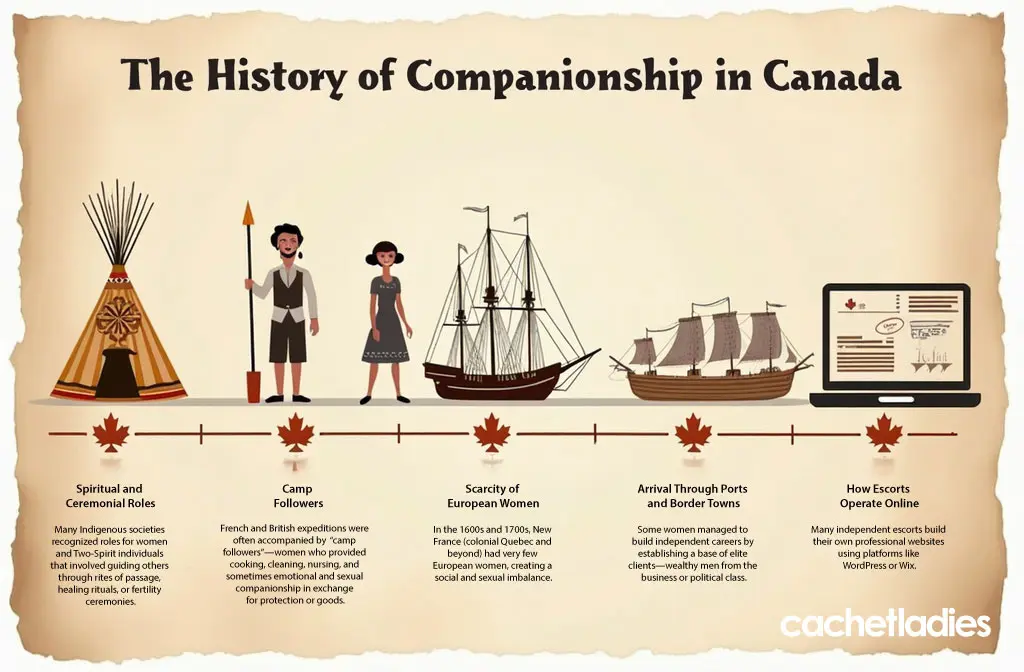
From sacred Indigenous roles to high-end digital companions, the evolution of escorting in Canada spans centuries of social change, legal reform, and cultural adaptation. This section highlights key eras and turning points in the history of sensual, emotional, and professional companionship.
Pre-Colonial Era (Before 1600)
Indigenous societies across Turtle Island (now Canada) honored diverse forms of companionship — spiritual guides, fertility partners, and ceremonial companions — that blurred modern boundaries between intimacy, healing, and social cohesion.
Among many matrilineal cultures, women exercised sexual autonomy and participated in rites of passage that included sensual or ceremonial union. Some oral traditions describe women as sacred caretakers of warriors or seasonal celebrations.
Note: Interpretations are based on scholarly research and oral histories. Always consult Indigenous-led sources, such as Native Women’s Association of Canada, for accurate and respectful representation.
Colonial Period (1600–1800)
With European colonization, the concept of escorting shifted into informal companionship roles. Camp followers — women who traveled with soldiers, fur traders, and merchants — offered care, sexual services, and emotional intimacy in exchange for protection or resources.
Ports like Quebec City and Halifax saw early brothels flourish discreetly. Though the Church publicly condemned such services, private letters and colonial records reveal tacit acceptance, especially where male-dominated settlements created natural demand.
This period introduced patriarchal control over sex work, contrasting Indigenous models of consensual autonomy with colonial efforts to regulate morality.
Confederation to Early 20th Century (1867–1914)
Following Confederation, Canadian cities grew rapidly, and so did demand for private companionship. Urban brothels became profitable ventures in industrial hubs like Toronto and Vancouver. Many were tolerated through unofficial police arrangements.
Newspapers reported on “fallen women” and “houses of ill fame,” combining sensationalism with a paradoxical advertising effect. Sex work wasn’t directly outlawed but was controlled via nuisance, vagrancy, and disorderly conduct laws.
The escorting concept remained ambiguous — neither legally defined nor socially accepted, but widely practiced in shadow economies.
World Wars and Social Reform (1914–1945)
Canada’s wartime mobilizations saw a surge in temporary brothels and unofficial escorting near military bases. Soldiers on leave sought intimacy, comfort, and escape — often in state-tolerated environments.
Health fears prompted harsh state interventions. Women suspected of sex work were detained, examined, and labeled under “social hygiene” policies. The government’s actions disproportionately targeted working-class and Indigenous women.
Despite the repression, escorting thrived underground, especially in nightlife hubs like Montreal. War catalyzed both demand and scrutiny, setting the stage for modern regulation debates.
Post-War Crackdown (1950s–1980s)
In the wake of post-war urbanization, cities cracked down on visible sex work. Zoning bylaws, morality squads, and social purity campaigns drove escorting deeper underground.
In response, “massage parlours” and discreet agencies flourished. Advertising relied on coded terms like “model,” “hostess,” or “companionship.” Phone books and classified ads became vital lifelines for both clients and providers.
While enforcement varied widely by province and municipality, escorting endured through adaptation, discretion, and community word-of-mouth networks.
The Internet Era (1990s–2000s)
With the advent of the web, escorting underwent a digital revolution. Providers built personal websites, agencies offered polished branding, and SEO became part of survival.
Review boards like TERB created semi-regulated ecosystems for vetting clients and promoting quality. Terms like GFE (Girlfriend Experience) and PSE (Porn Star Experience) became part of the vernacular.
Relevant Law: Section 213 of the Criminal Code criminalized public communication for sexual services, prompting a shift to encrypted email, burner phones, and web platforms.
Despite technological advances, legal ambiguity persisted — with occasional police stings, domain seizures, and targeted crackdowns based on advertising language.
Legal History of Escorting in Canada
Canada’s legal approach to escorting has evolved from broad moral codes to targeted statutes and constitutional rulings. The timeline below highlights major milestones — from the Criminal Code of 1892 to the controversial Bill C–36 and present-day legal uncertainty. Each entry includes semantic schema markup for search visibility.
1892: Creation of the Canadian Criminal Code
Canada’s first Criminal Code adopted many British common law provisions. Though sex work itself was not explicitly banned, associated activities like vagrancy, bawdy house keeping, and procuring were criminalized — effectively pushing escorting into the shadows while legitimizing state surveillance of marginalized women.
1972: Soliciting Added to the Criminal Code
Amendments to the Code prohibited public soliciting — often targeting women in visible urban areas. While intended to preserve “public order,” the law disproportionately affected racialized and transgender women, who were more likely to be stopped or charged based on appearance alone.
1985: Section 213 – Communication for Prostitution
Section 213 criminalized any public communication for sexual services, regardless of consent. The law pushed more sex work indoors and online, limited screening opportunities, and was later criticized as contributing to unsafe working conditions and violence against sex workers.
2013: Bedford v. Canada – Landmark Charter Case
The Supreme Court ruled unanimously that three prostitution-related laws — including the bawdy house ban and Section 213 — violated Section 7 of the Charter (security of the person). The case was brought by Terri-Jean Bedford, Amy Lebovitch, and Valerie Scott. Parliament was given one year to replace the laws.
2014: Bill C–36 – Nordic Model Enacted
Marketed as the “Protection of Communities and Exploited Persons Act,” Bill C–36 criminalized the purchase — but not the sale — of sexual services. Based on the Nordic model, it aimed to eliminate demand, but critics argue it created more danger by criminalizing clients and undermining worker screening.
2015–Present: The Legal Landscape in Flux
Since the adoption of Bill C–36, critics including Amnesty International and Canadian sex worker alliances have called for reform. Court cases continue to challenge the Nordic framework as unconstitutional, arguing it places providers at risk while pretending to protect them.
Sex workers — particularly those who are Indigenous, migrants, or transgender — report heightened police scrutiny, lack of legal protection, and economic vulnerability under the current laws.
A new Charter challenge launched in 2021 seeks to overturn C–36 and move toward full decriminalization of consensual adult sex work in Canada.
Commentary: Legal Contradictions and Risk
While escorting is not itself illegal, nearly all supporting activities — from advertising and accepting third-party help to using online platforms — are criminalized or undefined in law. This forces most providers to work in legal grey zones.
Lawmakers claim to protect workers while discouraging the very infrastructure that could improve safety and transparency. Legal experts and sex worker advocates increasingly agree: reform must prioritize consent, autonomy, and evidence-based harm reduction.
Recent Legal Cases Involving Escorts
From Supreme Court rulings to active Charter challenges, Canada’s evolving legal framework around escorting is shaped by key court decisions and activist-led litigation. These cases directly impact how safety, consent, and criminal liability are interpreted for sex workers and clients alike.
2015: R. v. Vuong and Leblanc – Consent and Exploitation
This Ontario Court of Appeal case clarified criminal responsibility in escorting scenarios involving underage individuals. The court emphasized that the prosecution must prove the accused knowingly exploited a minor and understood their age — reinforcing due process but also spotlighting risks for agencies without strict screening protocols.
2016: R. v. Downey – Constitutional Challenge Dismissed
In R. v. Downey, the accused sought to challenge the constitutionality of Bill C–36. The Supreme Court of Canada declined to hear the appeal, allowing lower-court decisions to stand. This outcome solidified the legal standing of the Nordic model, despite ongoing criticism from legal scholars and human rights groups.
2020: Charter Challenge – Canadian Alliance for Sex Work Law Reform
Led by the Canadian Alliance for Sex Work Law Reform, this constitutional challenge argues that criminalizing clients and third-party involvement violates rights to security, expression, and equality under the Charter of Rights and Freedoms. The case marks one of the largest coordinated legal efforts to overturn Bill C–36.
2022–2024: Constitutional Hearings
Recent legal proceedings in Ontario and British Columbia include affidavits from sex workers detailing violence, fear of police, and lack of recourse. Advocacy groups are pushing for the full repeal of criminal statutes affecting consensual adult sex work. A ruling is anticipated by late 2024, which may redefine Canada’s legal stance.
Commentary: The Legal Outlook
The future of Canadian escort law hinges on whether courts acknowledge the systemic harms caused by criminalizing clients and third-party safety mechanisms. Advocates call for a shift to decriminalization — similar to models in New Zealand — that prioritize worker health, screening rights, and legal recognition.
Regardless of outcome, these ongoing cases continue to challenge the current framework, highlighting contradictions between human rights ideals and law enforcement practices.

Escort Agencies in Canada
Profiles of leading agencies in Toronto, Montreal, Vancouver, and Calgary, with structured data for visibility across Google and Bing.
Escort agencies in Canada vary in visibility, professionalism, and discretion. Reputable agencies emphasize communication, health and safety, upscale experiences, and mutual respect between clients and companions.
Toronto – Cachet Ladies
Cachet Ladies is a premier Toronto escort agency offering luxury companionship with elite models. Their rigorous vetting, discretion, and polished service cater to high-profile clientele across the GTA.
Toronto – Cupids Escorts
Cupids Escorts has served the Toronto community since 2001, offering incall and outcall services with a wide array of companions. They promote respectful client interactions and transparent booking.
Vancouver – Vancouver Escorts
Vancouver Escorts caters to global business travelers and affluent locals, offering discreet luxury companionship rooted in confidentiality and refinement.
Montreal – Eleganza Escorts
Eleganza specializes in French Canadian and European companions, emphasizing intimacy, sensuality, and a sophisticated GFE experience within Montreal’s liberal culture.
Calgary – Platinum Companions
Serving Calgary’s professional clientele, Platinum Companions provides discreet appointments and GFE-centric experiences tailored to corporate expectations and discretion.
Agencies operate in a legal gray zone due to Bill C–36, which prohibits third-party benefit from sex work. Despite this, top agencies develop harm-reduction protocols, prioritize consent, and maintain professional booking platforms to enhance safety and service quality.
History of Escort Payments and “Donations”
A deep dive into the evolution of the term “donation,” historical payment practices, and modern financial challenges affecting providers and clients.
The term “donation” emerged as a legal euphemism, distancing transactions from prostitution laws. It underscores consensual, non-contractual companionship, helping mitigate risks tied to explicit financial arrangements.
From envelope handoffs to blockchain-based payments, escort compensation models reflect evolving privacy, risk, and technological concerns.
Timeline of Escort Payment Evolution
- 1900s–1950s: Discreet cash handoffs, often arranged via madams in private brothels.
- 1960s–1980s: “Donation” envelopes became standard, providing informal legal insulation.
- 1990s: Escort ads used coded language in print directories; cash remained the default.
- 2000s: Websites displayed donation charts with disclaimers like “time only.” E-transfers emerged but lacked anonymity.
- 2010s–Present: Bitcoin, e-gift cards, and apps like Cash App or Venmo enable low-traceability transactions with mixed legal reception.
Under Canada’s Bill C–36, selling sexual services is not illegal, but purchasing them is. This legal paradox incentivizes discreet language to avoid entrapment or misinterpretation.
Common phrases like “This donation is for my time only” remain fixtures in escort advertising, signaling boundaries and professionalism.
In today’s climate, escorts increasingly rely on pre-screened clients and digital transactions for safety. Yet, banks and payment processors often ban adult industry involvement, forcing reliance on pseudonymous or decentralized tools.
This financial marginalization leaves providers vulnerable to fraud and reduces access to legal recourse, underscoring the urgent need for regulatory reform.
Map of Known Escort Agencies in Canada
An interactive map displaying verified escort agencies across Canada, using city-level plotting for privacy.
Interactive map showing locations of verified escort agencies in Canada, including Cachet Ladies in Toronto, Cupids Escorts in Toronto, Vancouver Escorts, Eleganza Escorts in Montreal, and Platinum Companions in Calgary.
This map includes only publicly listed agencies with verified websites, plotted at city level to maintain privacy.
- Cachet Ladies (Toronto)
- Cupids Escorts (Toronto)
- Vancouver Escorts (Vancouver)
- Eleganza Escorts (Montreal)
- Platinum Companions (Calgary)
Map failed to load. Please try again later.
“; } }Why Elite Escort Agencies Are Safer and Better
Discover how exclusivity, rigorous screening, and higher standards empower providers and protect clients.
Agencies like Cachet Ladies prioritize consistency, trustworthiness, and safety, building reputations through rigorous screening and client relationships.
Higher donation rates filter out risky inquiries, ensuring respectful, well-matched connections.
Premium agencies use ID verification, encrypted communication, and booking deposits to ensure safe, respectful meetings.
Unverified services often lead to unpredictable outcomes, increasing risks for new or independent companions.
Elite agencies curate a small roster of compatible companions, ensuring mutual respect and exceptional chemistry.
Clients enter a space defined by elegance and clear expectations, not transactions.
Client Testimonial
“I’ve used agencies across North America, but Cachet Ladies stands apart. The professionalism, safety, and quality of experience are unmatched.”
▶️Hetaira(5th century BCE)
Origin: Ancient Greek
Modern Equivalent: Luxury escort
High-status courtesan in Ancient Greece who was educated, independent, and offered intellectual and sexual companionship, often to powerful men.
▶️Courtesan(Renaissance–1800s)
Origin: Italian/French
Modern Equivalent: Companion / GFE
A cultured woman who provided companionship, conversation, and sexual services to noble or royal patrons. Prominent in European courts.
▶️Geisha(1700s–present)
Origin: Japanese
Modern Equivalent: Hostess / Cultural Companion
Traditional Japanese female entertainer skilled in the arts of conversation, dance, and music. Geishas are not sex workers but have historically been linked to sensual performance.
▶️Concubine(Ancient to 19th century)
Origin: Latin / Chinese
Modern Equivalent: Mistress
A woman who lived with a man in a long-term sexual relationship without the legal rights of a wife. Common in dynastic courts and aristocratic societies.
▶️Mistress(1500s–present)
Origin: Middle English
Modern Equivalent: Sugar baby / Companion
A woman involved in an ongoing, typically discreet sexual relationship with a married or prominent man.
▶️Courrier du bois(1600s–1700s)
Origin: French (Canada)
Modern Equivalent: Adventurer / Companion hybrid
Unofficial trader/explorer who sometimes exchanged goods and services, including companionship, with Indigenous communities. Historically includes informal intimate exchanges.
▶️Working Girl(1900s–present)
Origin: American slang
Modern Equivalent: Street-based sex worker
Colloquial term used to describe a woman engaged in sex work, often independently or on the street.
▶️Escort(1950s–present)
Origin: Modern English
Modern Equivalent: Escort
A professional companion offering social, travel, or sexual services, typically through an agency or private advertising.
▶️Provider(1990s–present)
Origin: Online euphemism (USA)
Modern Equivalent: Escort / Independent provider
A term popularized on escort review boards to discreetly reference a person offering companionship or sexual services.
▶️Companion(1970s–present)
Origin: Neutral English
Modern Equivalent: GFE / Professional companion
A dignified term used by agencies and independents to imply non-transactional emotional or intimate service.
▶️GFE(1990s–present)
Origin: Acronym (USA)
Modern Equivalent: Premium service type
Stands for 'Girlfriend Experience' — an escorting style that simulates emotional and affectionate intimacy beyond just sexual activity.
Legal Note: This content is for informational purposes only and complies with Canadian laws under Bill C-36. Consult a legal professional for advice on escorting regulations.